ASNZS Fire Pump Replacement Plan for Minimum Downtime
Quick Answer: A proper AS/NZS fire pump replacement plan keeps fire protection ready, minimises downtime, and avoids costly surprises. It sets timelines, tests and compliance steps, spare parts strategy, and budget control. Kord Fire Protection can guide the process end to end, from site assessment to commissioning support.
In Australia, fire pump reliability is not a “nice to have”; it is the backbone of many facility fire systems. For sites that follow AS/NZS requirements, the best replacement approach starts with planning, not panic. And while it is easy to treat pump replacement like swapping an appliance, a fire pump job behaves more like a time sensitive mission: it needs structure, evidence, and tight coordination. Because if the pump is out, it is not just one asset that pauses. It is your whole safety story.
Our company, Kord Fire Protection, steps in as a vital partner by helping teams plan, schedule, document, and validate the replacement with the right level of rigour. If you are reviewing broader site readiness, Kord Fire Protection also supports fire protection services across Australia, which makes it easier to connect replacement planning with the rest of your compliance and maintenance priorities. Now, let us build a practical guide that industrial, retail, and commercial facilities can actually use.
1) Start with compliance mapping for AS/NZS scope and site reality
Before equipment is ordered, a replacement plan should map what the site needs to meet current AS/NZS expectations and how the existing installation behaves in real life. This includes the pump configuration, controller type, duty and standby arrangement, pipework layout, pressure set points, and alarm integration. Then, teams compare that to the new equipment requirements and the commissioning evidence needed for sign off.
Translate site conditions into proof requirements
Next, the plan should identify how operations will continue during works. For example, the facility might need phased changeovers so sprinklers and hydrant systems remain protected without long outages. Additionally, the team should review last service records, fault history, and any recurring issues like air in suction lines, sensor drift, or inconsistent pressure performance. Those notes often tell the real story faster than any spreadsheet.
- Confirm pump duty arrangement and acceptance criteria
- Review historical faults and performance trends
- Check control wiring, alarms, and interface points
- Document current pipework conditions and constraints
Transitioning from “what is on site” to “what must be proven” is where planning becomes valuable. It also helps the project team avoid rushed decisions that can stretch outages or create compliance headaches later. And if someone says, “We will wing it,” Kord Fire Protection has seen that movie. It does not end well.
2) Plan the replacement sequence to protect operations and safety
A strong plan defines a sequence that limits risk and downtime. In many facilities, the best approach uses staged works so the site retains system integrity while upgrades occur. For instance, teams often coordinate control panel changes, then perform mechanical connections, and finally run commissioning tests in a controlled window. If the site cannot afford any interruption, the sequence needs even more discipline, such as temporary arrangements and strict isolation procedures.
Set the order before the shutdown clock starts
To keep momentum, the plan should include access planning for switchboards, pump rooms, cable routes, and any flanges or isolating valves. Then, it should specify who owns each step: the mechanical contractor, the electrical contractor, the testing team, and the site facilities manager. When responsibilities are clear, fewer tasks get missed, and the job moves with less friction.
- Use a staged schedule tied to site shutdown windows
- Define isolation steps and permit requirements
- Set handover points between electrical and mechanical work
- Allocate commissioning time, not just “installation time”
Also, the plan must account for lead times. Pumps, controllers, sensors, valves, and cables often arrive on different dates. Therefore, a facility should order early, but also plan for what happens if a component arrives late. Kord Fire Protection can help align scope and procurement assumptions with realistic commissioning needs, so the team does not discover the missing part during testing. That discovery is never fun. It is like trying to cook without salt and pretending you are “going for a bold flavour.”
3) Conduct technical checks before ordering and before installation
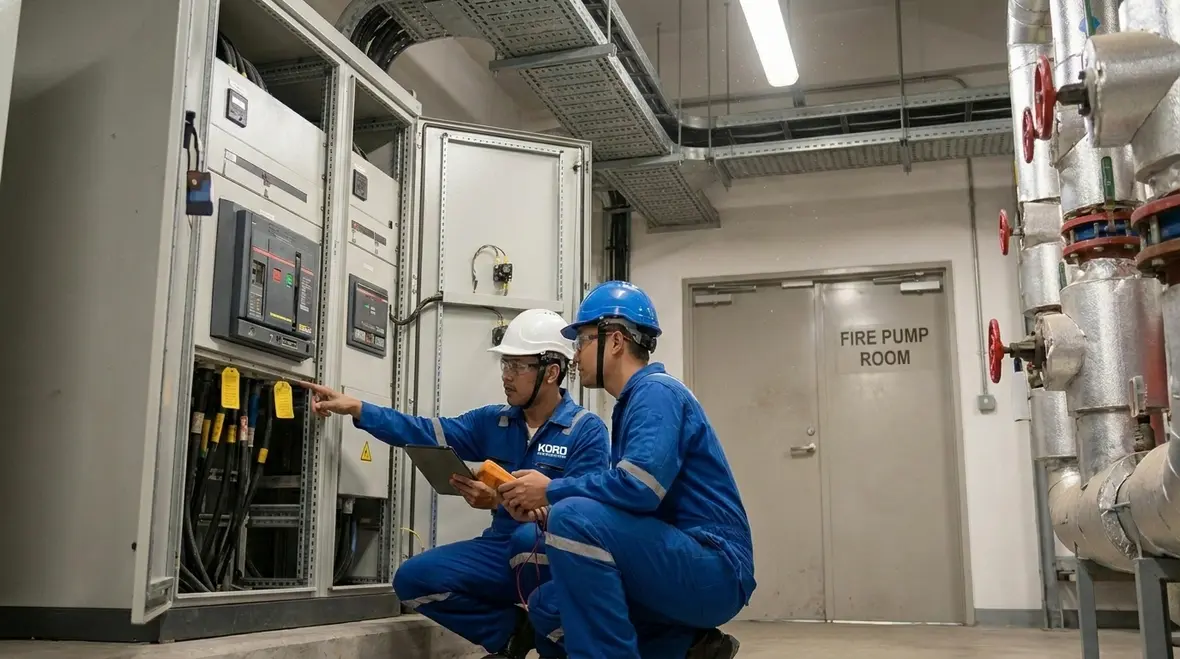
Many replacement delays happen because teams did not confirm technical details early. So, a planned approach starts with measurements and verification. This includes verifying pump data plate details, checking motor ratings, confirming voltage and starter type, and validating existing pipe sizes and elevations. It also includes pressure transducer locations, flow paths, and any vibration or noise constraints in the plant room.
Catch mismatch risks before they become rework
Where possible, the team should verify cable routes and termination points. If the new controller requires different wiring practices, planning must catch that before the electricians start tearing open trunking. Additionally, it should confirm standby arrangements and any interlocks with tank level, pressure maintenance units, or water supply monitoring.
- Verify pump and motor specs against drawings and nameplates
- Confirm pipe sizes, elevations, and flange compatibility
- Check controller inputs, outputs, and alarm mapping
- Validate cable routes and termination availability
When these checks happen up front, installation stays clean and commissioning stays fast. And since fire systems do not enjoy surprises, this is not just efficiency. It is risk control. Kord Fire Protection works with facilities to turn these checks into clear scope actions. As a result, the site gets fewer “interpretation moments” between contractors, which keeps the project calm and predictable.
4) Budget and procurement planning that avoids the usual traps
Fire pump replacement budgets often look simple until reality arrives with callouts, valve upgrades, crane time, shutdown changes, or unexpected pipework work. Therefore, a good plan builds allowance for commissioning support, testing labour, isolation equipment, and documentation. It also plans for spares and consumables that make future maintenance easier, like gaskets, isolating valve components, and controller parts.
Budget for the whole job, not just the shiny new pump
Procurement planning should also consider lead time and compatibility. For example, a new pump might require upgrades to the controller interface or the pressure sensing setup. If the plan assumes direct swap, it can create rework. However, when the site validates system interfaces early, procurement becomes a step-by-step process, not a gamble.
- Include commissioning and verification in the budget
- Allow for valves, fittings, and minor pipework changes
- Plan spares and consumables for maintenance readiness
- Build in time for documentation and handover
A replacement plan should also decide who signs off ordering milestones, who tracks supplier dates, and what the team does if one item slips. That sounds basic, but it is the sort of basic that saves projects. And here is a small joke with big truth: people often budget like they are replacing a toaster. A fire pump job does not toast bread; it protects lives and keeps inspections from turning into a courtroom drama.
5) Commissioning, testing, and documentation for long term confidence
Once installation finishes, the job is not “done.” Commissioning and proof testing matter because they confirm the system works as designed under real conditions. The plan should specify what tests run, what data gets captured, and who reviews outcomes. It should also include functional checks of controllers, alarms, and auto start behaviour, plus verification of pressure control and performance response.
Turn installation into documented proof
Equally important, the plan should control evidence quality. A facility needs clear records for compliance audits and ongoing maintenance. Therefore, teams should prepare commissioning reports, test result logs, as built information, and updated maintenance schedules. Transitioning from paper to proof is how facilities stay confident when the next inspection arrives.
- Run functional checks for auto and standby operation
- Verify alarms, interface points, and controller settings
- Capture test data and results in an organised record set
- Update drawings, schedules, and maintenance documentation
Kord Fire Protection can support commissioning readiness by aligning test activities with site risk, documenting outcomes clearly, and ensuring the replacement does not create gaps in service history. In short, the facility gets a smoother closeout, not a messy drawer full of loose PDFs.
6) Build an ongoing maintenance plan after the replacement
A replacement plan should include what happens after the new pump starts working. Maintenance readiness is where reliability is protected over the long run. Therefore, the facility should establish a schedule for routine checks, performance observations, vibration monitoring where applicable, and controller inspections. It should also confirm that spares are available and that staff know the basic escalation steps when anomalies appear.
Make the handover useful for the next five years, not just the next five days
Further, the maintenance plan should align with site operations. For busy facilities, it can help to coordinate maintenance with planned downtime windows. At the same time, teams should set clear service intervals and response targets for fault events. When the facility keeps the pump room consistent and records changes carefully, the system remains stable and easier to manage.
- Set maintenance intervals and define response actions
- Confirm spare parts availability and replacement triggers
- Coordinate maintenance with operational shutdown windows
- Keep records so future troubleshooting stays quick
This part is easy to undercook because everyone feels relieved once the pump starts and the alarms behave. But long term reliability is built after the applause, not during it. And yes, doing this reduces the odds of a future surprise. The kind where a pump fails right when the building schedule says it should not. Like a pop quiz in the middle of a meeting. Nobody enjoys that.
FAQ
Conclusion
Fire pump replacement planning works best when a facility maps requirements, schedules staged works, validates technical details, budgets for commissioning evidence, and then maintains the system after handover. That is where Kord Fire Protection becomes a vital partner. The team supports industrial, retail, and commercial sites across Australia with calm coordination and solid documentation, so the replacement stays controlled and confident. If you are planning an upgrade, contact Kord Fire Protection and get a plan that holds up in the real world.