AS 2941 Fire Pump Suction and Discharge Requirements
Quick Answer: AS 2941 sets the Australian expectations for fire pump suction and discharge piping, fittings, and installation practices. It helps prevent cavitation, pressure losses, and unreliable performance. Kord Fire Protection can partner with the project team to review designs, check installs, and verify the system performs when it matters.
For projects that need a broader compliance and verification lens, Kord Fire Protection also supports fire protection services across Australia, which fits naturally alongside pump design reviews, site checks, and commissioning support.
AS 2941 and why it matters for fire pump reliability
In Australia, fire pumps must work with the confidence of a calm voice in a loud room. That is exactly why AS 2941 Fire Pump Suction and Discharge Requirements exists. Within the first stretch of the system, AS 2941 addresses how suction lines feed the pump and how discharge lines deliver water to the network. When these elements are wrong, the pump can still spin, but it will not do the job. And nobody wants a fire pump that performs like a gym buddy who “meant well” but never showed up.
Fire protection is not just a pump and a couple of pipes. Therefore, the standard focuses on hydraulic behavior, practical install details, and how water moves through the system during a real demand. In turn, that means facilities in industrial, retail, and commercial spaces can reduce the risk of underperformance across Australia, from short build timeframes to complex refurbishments.
Where suction issues usually start and how to prevent them
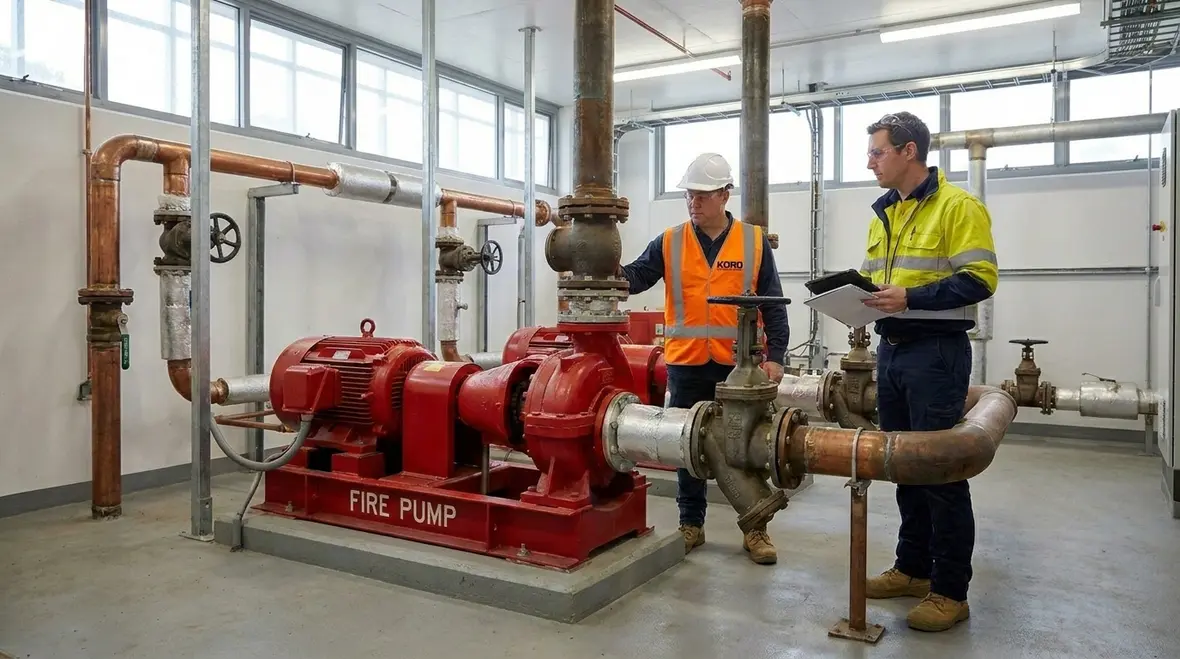
Suction piping often becomes the quiet troublemaker. Initially, it looks fine on paper, but real-world constraints show up fast: changes in elevation, valves that add restriction, poor support, and debris collection. AS 2941 anticipates these realities and pushes teams to control conditions that lead to cavitation and loss of prime.
To keep suction stable, the project team should consider the following:
- Pipe sizing and layout: they must support the required flow without creating excessive velocity spikes that encourage cavitation.
- Straight runs and fittings: they should not create unnecessary turbulence right at the pump inlet.
- Valve selection and placement: the chosen valves must not introduce pressure losses that starve the pump.
- Strainers and debris control: they should be installed and maintained so they do not clog quietly for months.
- Air management: air entrapment can ruin suction performance, even when the discharge side looks perfect.
Additionally, our company, Kord Fire Protection, can act as a vital partner by translating the standard into practical checks on site. Designers and installers move quickly, and then commissioning day arrives like an unexpected plot twist. Kord helps teams avoid that moment of “how did this pass?” by reviewing drawings early, then validating installation intent as the work progresses.
Common suction side mistakes worth catching early
This is where small choices become expensive lessons. A line that pinches tighter than expected, a valve placed where access is awkward, or a strainer that is technically present but practically ignored can all chip away at pump confidence. The suction side rewards boring excellence. Straightforward layout, sensible access, and clean hydraulic thinking do not win awards for drama, but they absolutely help a fire pump avoid behaving like it woke up on the wrong side of the plant room.
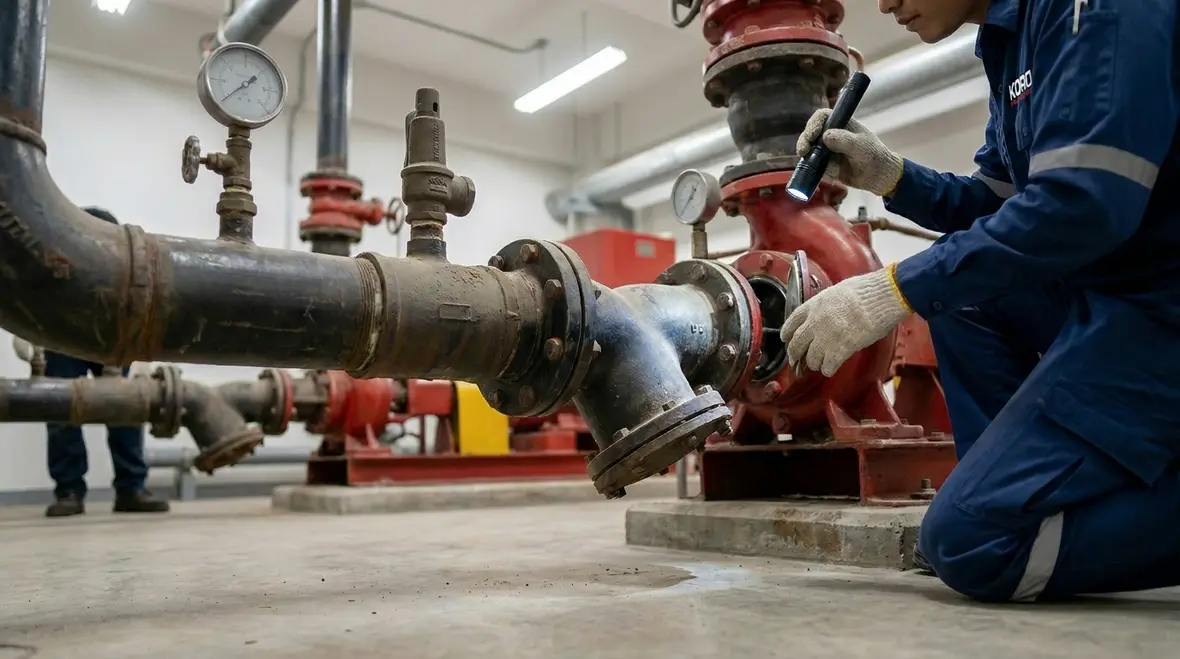
Discharge piping: pressure delivery, losses, and system response
Discharge piping does not just carry water. Instead, it must deliver the right pressure at the right time while resisting losses that stack up through bends, check valves, and offsets. If the discharge side loses too much energy, the water supply may fail to meet the intended fire scenario, even if the pump itself performs nominally.
Under AS 2941, the discharge arrangement should support stable delivery. Therefore, teams should pay attention to how water travels from the pump to the system connections. That includes:
- Hydraulic losses: the layout must minimize avoidable restrictions that reduce pressure available to sprinklers and hydrants.
- Check valve behavior: it should prevent backflow without introducing problems that reduce pump efficiency.
- Pipe support and alignment: supports need to hold steady under vibration and thermal movement so fittings do not shift under load.
- Gauge points and test access: the system must allow controlled checks so teams confirm performance, not guess it.
In many facilities, discharge lines run through plant rooms that were never designed for “yet another” modification. So, the work must fit the space while still meeting the hydraulic and installation expectations. Kord Fire Protection supports this balancing act. We help coordinate changes with builders, mechanical contractors, and asset owners so the discharge side matches the project intent, not just the as-built convenience.
Why discharge details decide whether good pump performance actually reaches the system
A pump can do its job beautifully and still be let down by the network immediately after it. That is the sneaky part. Pressure losses do not usually announce themselves with a marching band. They collect quietly through fittings, direction changes, valve choices, and cramped routing decisions until the available pressure at the point of demand is lower than expected. Good discharge design is less about making the pipework look impressive and more about letting the water get out of its own way.

Commissioning and verification that actually prove performance
Commissioning is where the story gets real. A set of drawings can look flawless, but water does not read drawings. It follows friction, it reacts to air, and it punishes poorly arranged pipework. Therefore, verification must connect the requirements of AS 2941 with measured results during testing.
A strong verification approach includes:
- Pre test checks: confirming valve positions, system cleanliness, supports, and no hidden blockages.
- Performance checks: measuring discharge pressures, suction conditions, and flow response against the design basis.
- System response review: ensuring the whole supply chain behaves as expected during demand.
- Documentation: recording results so stakeholders can trust the evidence later.
And yes, testing can be mildly dramatic. One moment everything is quiet, the next the pump is doing what it was built to do, and the team gets the data it needs. Kord Fire Protection brings that calm, methodical energy. We support facility teams across Australia by helping them move from “we think it works” to “we know it works,” which matters when the asset owner needs a dependable compliance trail.
How to integrate AS 2941 checks across teams
In industrial, retail, and commercial projects, fire pump work crosses multiple disciplines. Typically, the electrical team focuses on starters and controls, the mechanical contractor owns installation, and the fire engineer owns calculations. Meanwhile, the asset owner wants reliability, and maintenance teams want access. AS 2941 becomes the common ground that prevents the handover from falling apart.
To integrate effectively, teams should:
- Align early on suction and discharge arrangement, including access for inspection and testing.
- Confirm design intent before installation is final, so field changes do not break hydraulic assumptions.
- Use a structured checklist for site verification at key milestones.
- Coordinate documentation so test results map back to the specific requirements.
Here, Kord Fire Protection becomes a vital partner because we can support the entire journey. We do not just show up at the end. Instead, we help teams connect design, installation, and commissioning into one consistent outcome, so multiple stakeholders do not chase separate versions of the truth. That saves time, avoids rework, and helps protect schedules across Australia.
| AS 2941 focus area | What teams should practically check |
|---|---|
| Suction side behavior | Pipe layout, air control, valve restriction, strainers, and conditions that could trigger cavitation or loss of prime |
| Discharge pressure delivery | Hydraulic losses, check valve setup, support and alignment, and test points for verification |
| Commissioning proof | Measured pressures and flow response, with documentation that ties back to the project basis |
Ready to strengthen your fire pump performance?
When fire pumps must perform, “close enough” does not cut it. Kord Fire Protection can help industrial, retail, and commercial facilities across Australia align suction and discharge installation with AS 2941 expectations, then verify performance through a structured commissioning approach. If your project needs clarity, reduced rework, and dependable evidence, contact Kord Fire Protection today. Let’s make sure your system delivers when it is called, not when it is convenient.