AS 4072.1 Fire Stopping for Service Penetrations in Australia
Quick Answer: AS 4072.1 fire stopping sets the rules for sealing gaps and openings around service penetrations so fire cannot spread through them. It guides how to choose, install, and finish fire-stopping systems for pipes, cables, and ducts in industrial, retail, and commercial buildings. Done correctly, it protects lives and keeps operations running.
If your site needs a practical path from penetration risk to compliant delivery, Kord Fire Protection can support that process through its fire protection services across industrial, retail, and commercial environments in Australia.
What AS 4072.1 fire stopping really demands
In Australia, AS 4072.1 Explained: Fire Stopping for Service Penetrations matters because service penetrations act like hidden doorways for smoke and flames. The key idea is simple: the standard focuses on fire stopping that performs as a barrier where services pass through walls, floors, and slabs. It also pushes good workmanship, correct system selection, and repeatable installation methods. That sounds straightforward on paper, but on active sites it takes planning, coordination, and a very low tolerance for “that should be fine.”
Now, if you think fire stopping sounds like the kind of task people do later, you are not alone. Many sites treat it like a to do list item that never ends. However, the moment a compartment needs to hold, the quality of your penetrations and seals decides the outcome. A wall can be beautifully rated, documented, and signed off, but if the opening around a cable bundle or pipe run is left incomplete, that rating starts looking more like a polite suggestion than a protective barrier.
Kord Fire Protection becomes a vital partner here, because it helps teams move from guesswork to documented, compliant outcomes across industrial, retail, and commercial facilities in multiple locations across Australia. That matters because consistency is what turns compartmentation from a theory into something that actually works during heat, smoke movement, pressure change, and the general chaos that comes with a real fire event.
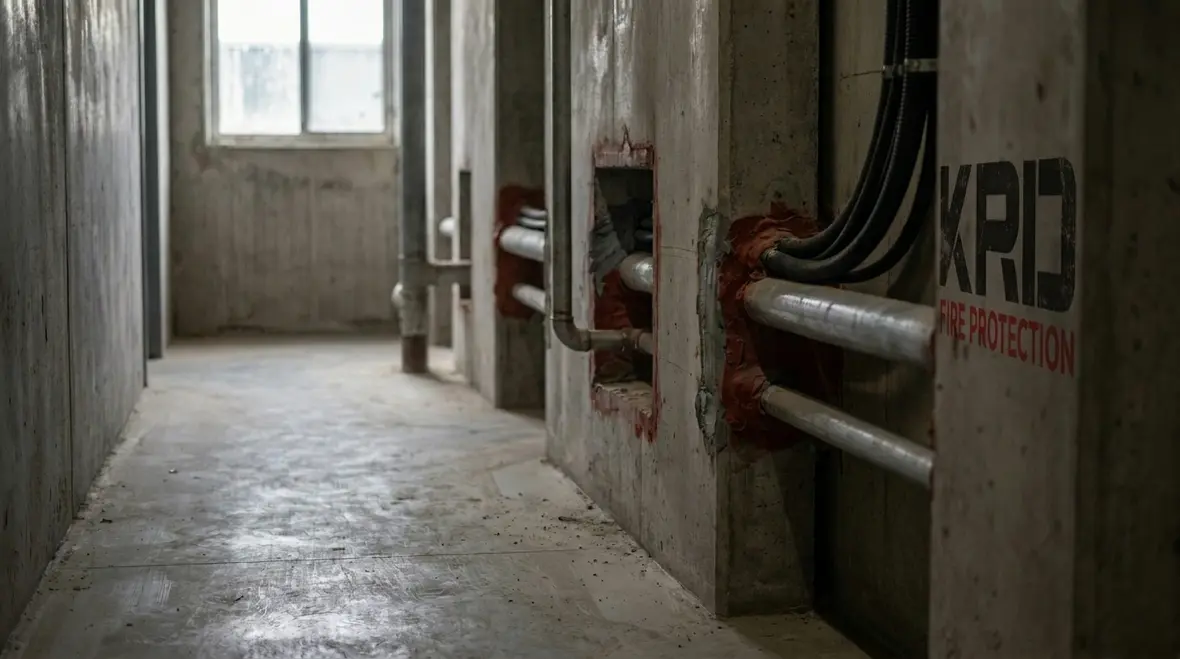
How service penetrations become fire and smoke pathways
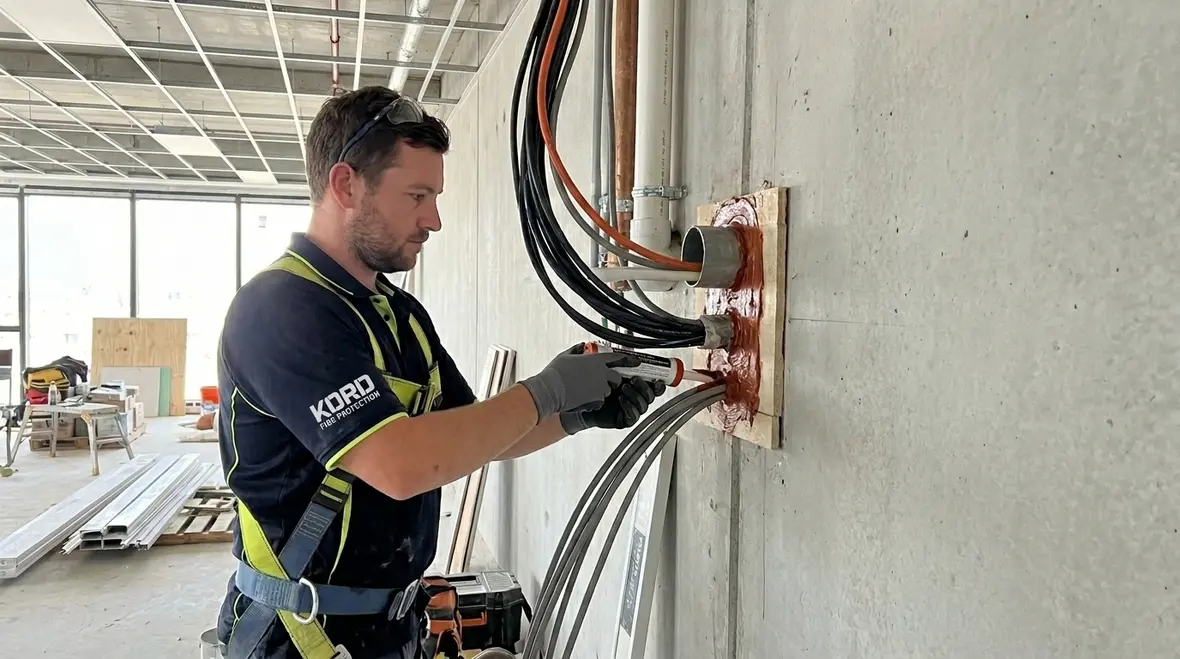
Fire does not need a grand entrance. It only needs the right gap. Service penetrations include openings around electrical conduits, sprinkler lines, mechanical ducts, cable trays, data runs, gas lines, and water pipes. Even when the wall or slab is rated, the penetration can undermine that performance if the fire stopping is missing, degraded, or installed incorrectly. In practical terms, that means the part of the building that looked least dramatic can become the part that causes the most trouble.
Furthermore, fire and smoke transfer depends on movement. During a fire, materials expand and structural elements deform. That means a seal that relies on a fragile fit can fail under heat. Meanwhile, gaps can also appear during maintenance, when trades open up walls to pull cables or reroute services, then close them without matching the original fire-stopping system. This is where buildings quietly accumulate risk over time. The compartment was protected, then altered, then partly patched, then altered again, and suddenly no one is entirely sure what still performs as intended.
Kord Fire Protection typically supports facilities teams by planning fire-stopping work with the actual service layout in mind, not just the wall surface. That approach helps reduce the “we’ll patch it” mindset, which is great for patching a shirt and terrible for fire compartmentation. Looking at the penetration as a system condition rather than a surface defect changes the quality of the outcome immediately.
Why penetration risk grows over time
A new building might begin with tidy penetrations and clear records, but services rarely stay still for long. Tenants expand, production areas change, data requirements grow, mechanical systems are upgraded, and maintenance crews need access. Every one of those changes creates another chance for a rated element to be disturbed. Without disciplined reinstatement, the fire-stopping condition across a site can slowly shift from controlled to questionable without setting off any obvious alarm bells.
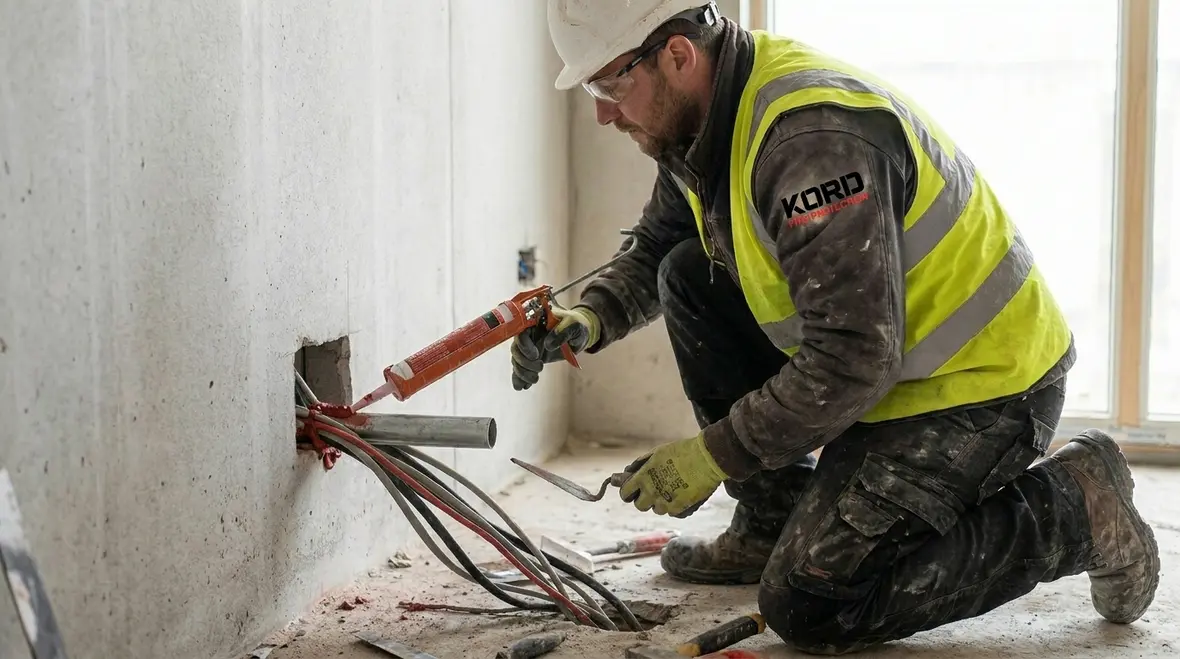
Choosing the right system under AS 4072.1
AS 4072.1 fire stopping is not a single product you can buy and hope for the best. Instead, it expects a system. A proper system includes the seal material, backing support if needed, surface preparation, and a method that matches the service type and penetration configuration. That distinction is important, because many problems start when people think a cartridge of sealant automatically equals compliance. It does not. A suitable result comes from the right system used the right way in the right opening.
Therefore, the decision process usually starts with the penetration details. Teams consider what passes through the building element, the size of openings, the number of services, and whether services are loose, fixed, or capable of movement. Next, they assess the building element, such as whether the penetration sits in a wall, floor, or slab, and whether the surface is concrete, masonry, or another substrate. Those details shape installation choices more than many people expect, because the same material can perform very differently when the surrounding conditions change.
After that, they select a fire-stopping approach that fits. This may include intumescent solutions, mineral based materials, cast in place systems, or other engineered methods, depending on the rated design requirements and the service environment. The point is not to make the opening look sealed. The point is to achieve a penetration treatment that supports the fire-resisting function of the building element in a reliable, repeatable way.
Here is where Kord Fire Protection helps most: it coordinates selection with site conditions, so the installed outcome matches the compliance intent. In other words, it turns technical requirements into real-world installation steps that trades can follow and inspectors can verify. That translation work is often the difference between a neat-looking seal and a defensible one.
Common selection mistakes to avoid
One of the most common mistakes is choosing around convenience instead of compatibility. Another is assuming that if one system worked somewhere else, it must work here too. Different service types, movement expectations, opening sizes, and substrates can change the entire requirement. Fire stopping rewards specificity. The more accurately teams define the penetration condition, the better the final system choice tends to be.
Installation steps that keep compartments intact
The standard expects work that is installed the right way, not just installed quickly. A good installation usually includes careful preparation, correct packing and thickness, and consistent finishing. If installers leave voids, over widen gaps, or skip required backing, fire and smoke can find routes through the tiny, invisible spaces. Those spaces are rarely tiny once a fire starts doing physics.
Also, crews need to protect surrounding finishes. If fire stopping gets smeared, unsupported, or disturbed by subsequent trades, performance can change. That is why workmanship and sequencing matter. When cable trays get added after fire stopping, for example, a seal can be compromised unless the system is reinstated in a controlled manner. Good fire stopping is often less about one heroic install and more about site discipline over the full life of the area.
To keep quality steady, Kord Fire Protection can align with site workflows so penetrations get sealed, labeled, and verified with clear documentation. This reduces rework and helps facilities teams maintain audit-ready records across industrial, retail, and commercial environments. Better still, it helps prevent the awkward moment when someone points at a penetration during an inspection and the room suddenly develops a strong interest in the floor.
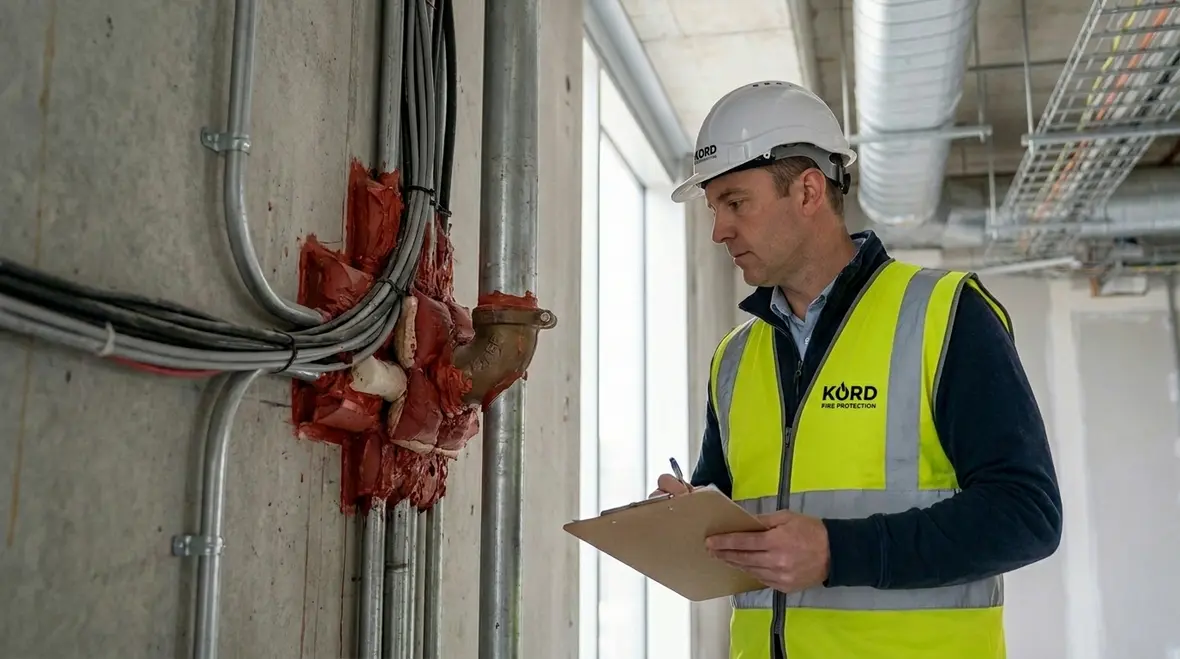
Testing, documentation, and compliance readiness for audits
Fire stopping is one of those topics that feels quiet until an auditor, insurer, or compliance review asks pointed questions. At that point, it helps to show more than “trust us.” Good documentation supports the installation method, location coverage, and system details. It gives facilities teams something concrete to rely on when building changes occur and someone needs to understand what was installed, where it was installed, and what should happen if the area is disturbed later.
Moreover, facilities teams benefit from a clear record of what was sealed, where services pass, and when remedial work occurred. This supports ongoing maintenance because future alterations can be planned around known protected penetrations. Instead of guessing at hidden risks, teams can work from a clearer baseline. That improves speed, reduces unnecessary opening up of finished areas, and lowers the chance of accidental non-compliant alterations.
Transitioning from reactive patching to structured control also helps with operational continuity. Instead of disrupting entire areas later, planned fire stopping work aligns with maintenance windows, reduces downtime, and keeps retail and commercial spaces open where possible. That is one reason Kord Fire Protection positions itself as more than a contractor. It becomes a partner that supports compliance readiness through methodical reporting and practical guidance for teams across Australia.
What facilities teams should keep on file
Useful records usually include penetration locations, service types, installation dates, system references, notes on remedial works, and evidence that later modifications were reinstated correctly. If the building has multiple tenancies or staged upgrades, that record set becomes even more valuable. It turns fire stopping from a vague maintenance memory into a managed asset protection process.
Common failure points and how Kord helps prevent them
Many fire-stopping problems come from predictable habits. One common issue involves penetrations reopened for cable pulls. Another involves mismatched materials, where the sealant used does not match the system design. Some failures also come from poor packing density, gaps behind the seal, or insufficient support for larger openings. None of these are especially mysterious, which is both useful and slightly frustrating. The risks are known. The challenge is controlling them consistently.
Additionally, movement matters. Services can vibrate or shift slightly over time. If the fire-stopping system lacks the right properties for that environment, performance can degrade before anyone notices. This is why fire stopping should never be treated as decorative caulking with better marketing. It has to suit the conditions it will face, both on day one and after years of ordinary building use.
Here is a practical way to think about it. If fire stopping is the bouncer at the club, then every penetration is a back door. You want that bouncer to recognize the right credentials every time, not just sometimes on a Friday night. Kord Fire Protection helps facilities teams reduce those risks by supporting consistent system selection, installation quality checks, and controlled reinstatement after service works. That means fewer call-backs, fewer compliance surprises, and more confidence that compartmentation holds when it counts.
AS 4072.1 fire stopping for facilities: a smarter business approach
Facilities leaders want protection, but they also want stability. Correct AS 4072.1 fire stopping supports both by improving safety outcomes and reducing disruption. When fire stopping work is planned and executed properly, teams can avoid repeated break and reseal cycles, reduce operational downtime, and maintain clearer compliance pathways. That is not just a safety win. It is a planning win, a maintenance win, and a business continuity win.
Furthermore, across industrial, retail, and commercial sites, there is often a constant flow of maintenance and upgrades. Fire stopping needs to keep up with those changes, not fall behind. Kord Fire Protection can help coordinate fire-stopping needs with the reality of ongoing service penetration work, so buildings stay protected through day to day operations. That matters most in the places where service changes are normal, because normal activity is exactly where compartmentation can quietly unravel if no one owns the process.
Ultimately, this becomes good risk management. It also helps protect business continuity, because an incident caused by failed compartmentation can force closures, investigations, and expensive remediation. Fire stopping is rarely the flashiest part of a project, but it is one of the clearest examples of how disciplined detail protects bigger operational goals.
FAQ
Conclusion: make fire stopping a controlled, ongoing advantage
Fire stopping for service penetrations cannot be treated like a quick patch. It needs the right system, correct installation, and repeatable control through maintenance cycles. When a site follows AS 4072.1 requirements with discipline, compartmentation stays credible and operational disruption stays lower. Kord Fire Protection can support your industrial, retail, and commercial assets across Australia with practical, compliant fire-stopping delivery and clear documentation. Reach out to Kord Fire Protection to plan your next service penetration works the right way.